More on AI, College Decisions and the danger of heuristics


Happy Friday everyone.
For this week's article I wanted to do two things:
- Preview some of the research I'm doing on AI and college decisioning
- Explore a common heuristic and how it came to be
As I mentioned in my previous piece[1], I think it's inevitable that people will increasingly use AI chatbots as an extension of their college decision-making process. I also noted what happens when experts poke at these tools to see what they're saying: the structured evaluations land at about a C grade[2], and my own attempt to use AI to source that very piece produced three confidently wrong citations out of four before I pulled the primary documents myself.
A reasonable person might take all that and say, "Okay, but what does that mean?" Are we being objective, or are we just old curmudgeons upset that the world has moved on? It's something I've been thinking about a lot, and over the next few months I'll be exploring how exactly we evaluate LLMs and their responses: what objective standard we judge them against, and how we track what people are actually getting out of them.
For today, though, we're just gonna set the stage with one example, explore how it came to be, and walk through why it's dangerous as presented.
Let's take this example of what a person might ask an LLM:
"I am considering getting a nursing degree, and I think I'll end up getting ~$80K in debt. How should I think about this?"
One of the things you'll see consistently in the response from one LLM provider is something along the lines of:
"My rough decision rule: the plan is more defensible if the final debt is no greater than a conservative first-year gross salary, most borrowing has strong government protections…"
And to be fair, the answer doesn't stop there — it hedges, notes the government protections, and suggests keeping payments under about 10% of gross income. Line by line, it reads like a responsible answer.
Let's focus on that first load-bearing clause: debt no greater than a first-year salary. Debt under salary, "workable." Debt over salary, warning lights.
Okay, but what is that rule???
Where does it come from? Well… using the AI to run down its own rabbit hole, we land on a 2010 Mark Kantrowitz paper[3] — one where he's exploring much more robust ways of thinking about college affordability.
So basically: there's a throwaway line in a paper with an incredible amount of sophistication and nuance — a supporting player even in its own paper — that ends up as a rough heuristic, repeated in alot elsewhere, including on a government site which in turn becomes the basis of analysis for student debt.
Huh.
Okay… so whats the problem?
Running down the rabbit hole of where the rule comes from
The question of "how much student debt is too much" has a rich research history. Economists were building models for this in the late 1960s[14]. By 2006, researchers like Sandy Baum and Saul Schwartz had landed somewhere sophisticated[4]: there is no single safe percentage, because affordability depends on what's left after you cover basic living expenses. Their proposal: no required payments for anyone below 150% of the poverty line, measure repayment against income above that floor, and adjust for family size and circumstances.
If that structure sounds familiar, it's because it's essentially the architecture I used for the Financial GPS framework[5]. I didn't invent the idea of measuring debt against discretionary income. I picked up a thread researchers had been working for decades.
The 2010 Kantrowitz paper sits squarely inside that tradition. It's a sophisticated piece of work — it weighs payment burdens against gross income and discretionary income, walks through default statistics, even flags that cost of living varies by region. The "don't borrow more than your starting salary" line appears as a shorthand — a translation of a payment-burden argument, with the assumptions stated right there: at 2010 interest rates, on a ten-year term, debt equal to salary meant handing about 13.8% of your gross income to your loan servicer.
And out of all of that — decades of careful thinking about floors and burdens and family circumstances — what survived is the one sentence. The CFPB repeats it with hedges ("If possible, try not to…"[6]). The personal-finance listicles repeat it without them. And now LLMs lean on it, because it's simple and straightforward: two numbers, one comparison, no judgment calls. The floors, the percentages, the regional differences, the interest rate that gives the sentence its meaning — hand-waved, at best.
So let's put the dropped parts back and see what this tells us in this scenario.
Unpacking the Heuristic with real numbers
Let's give the rule its best case. Standard ten-year repayment, and generously pretend all $80,000 of our nursing student's debt is federal undergraduate borrowing at this year's 6.52% rate[7]. (Hold that "generously." We'll come back to it.)
The payment is $909 a month, every month, for ten years.
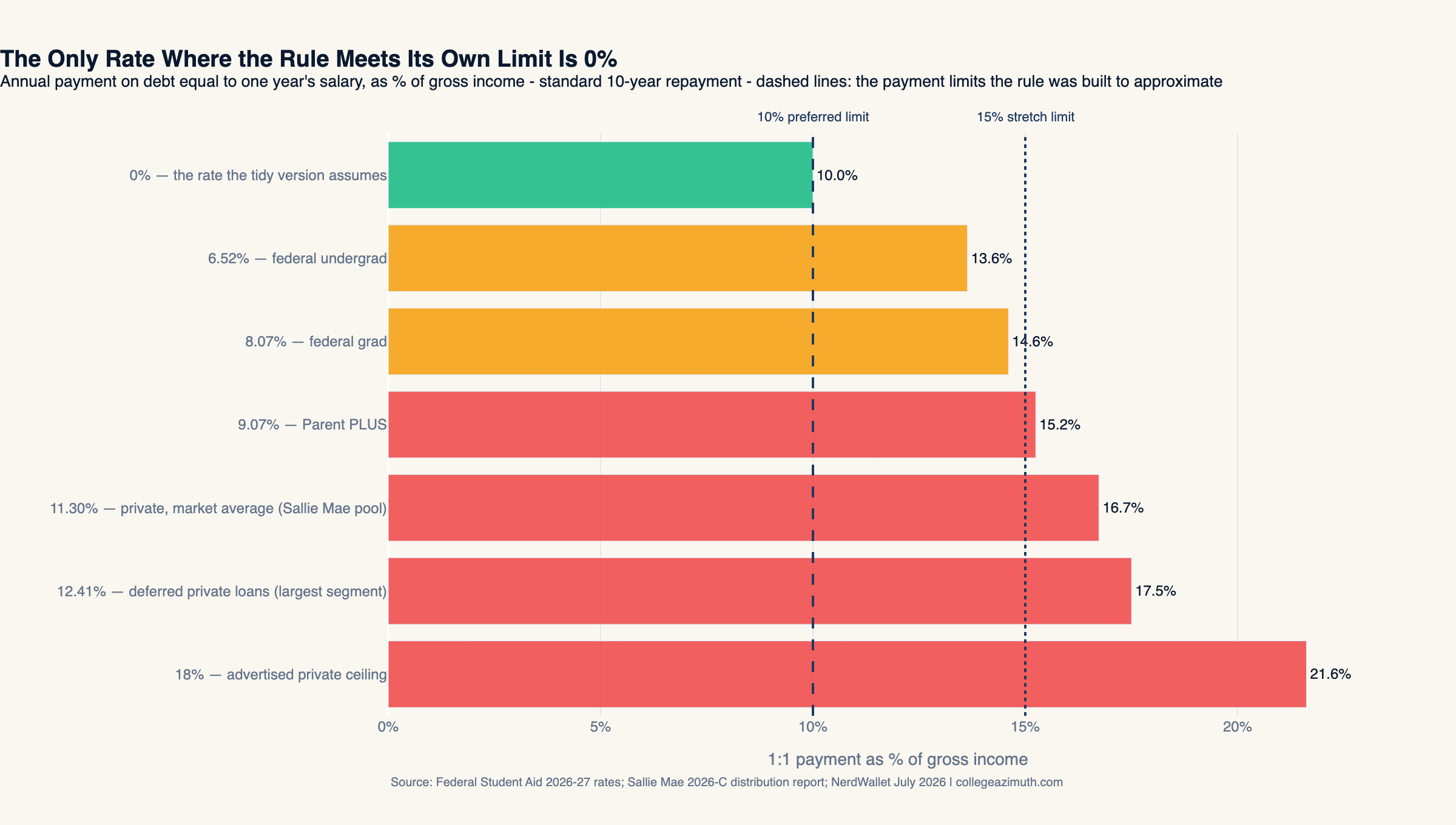
The rule's promise is that debt under your starting salary means you can repay in ten years. And that's technically true — $909 a month will, in fact, retire the loan. But notice what it costs: at 6.52%, debt equal to your salary means handing 13.6% of your gross income to your loan servicer. The tidy version people carry around — "debt equal to salary is about 10% of income" — is only true at an interest rate of zero. Nobody borrows at zero.
Here's the bigger problem, though: gross income doesn't pay loans. What's left after rent, groceries, insurance, and a car payment pays loans. That's the whole idea behind the Financial GPS: subtract basic living costs — I use $22,590, which is 150% of the federal poverty line, the same floor federal repayment programs use — and measure the payment against what's actually left.
Run the rule through that lens and it stops being one rule at all:
| Starting salary | Debt at 1:1 | Payment | % of discretionary income | GPS tier |
|---|---|---|---|---|
| $30,000 | $30,000 | $341/mo | 55% | High Risk |
| $45,000 | $45,000 | $511/mo | 27% | High Risk |
| $60,000 | $60,000 | $682/mo | 22% | High Risk |
| $80,000 | $80,000 | $909/mo | 19% | Concerning |
| $120,000 | $120,000 | $1,364/mo | 17% | Concerning |
A graduate earning $30,000 who followed the rule to the letter hands over 55% of every dollar above subsistence for ten years. At $80,000 — our nurse, sitting exactly on the rule's boundary — it's 19%, which in GPS terms is Concerning. And to be clear about the scope of this claim: under this scenario — standard ten-year repayment, today's federal rate, the national cost-of-living floor — borrowing 1:1 never lands in the Good tier at any salary. Not at $80,000. Not at $200,000. The burden bottoms out at 13.6% of discretionary income as salaries rise — permanently Concerning. Different assumptions move the numbers, and we'll move them. It doesn't get better from here.
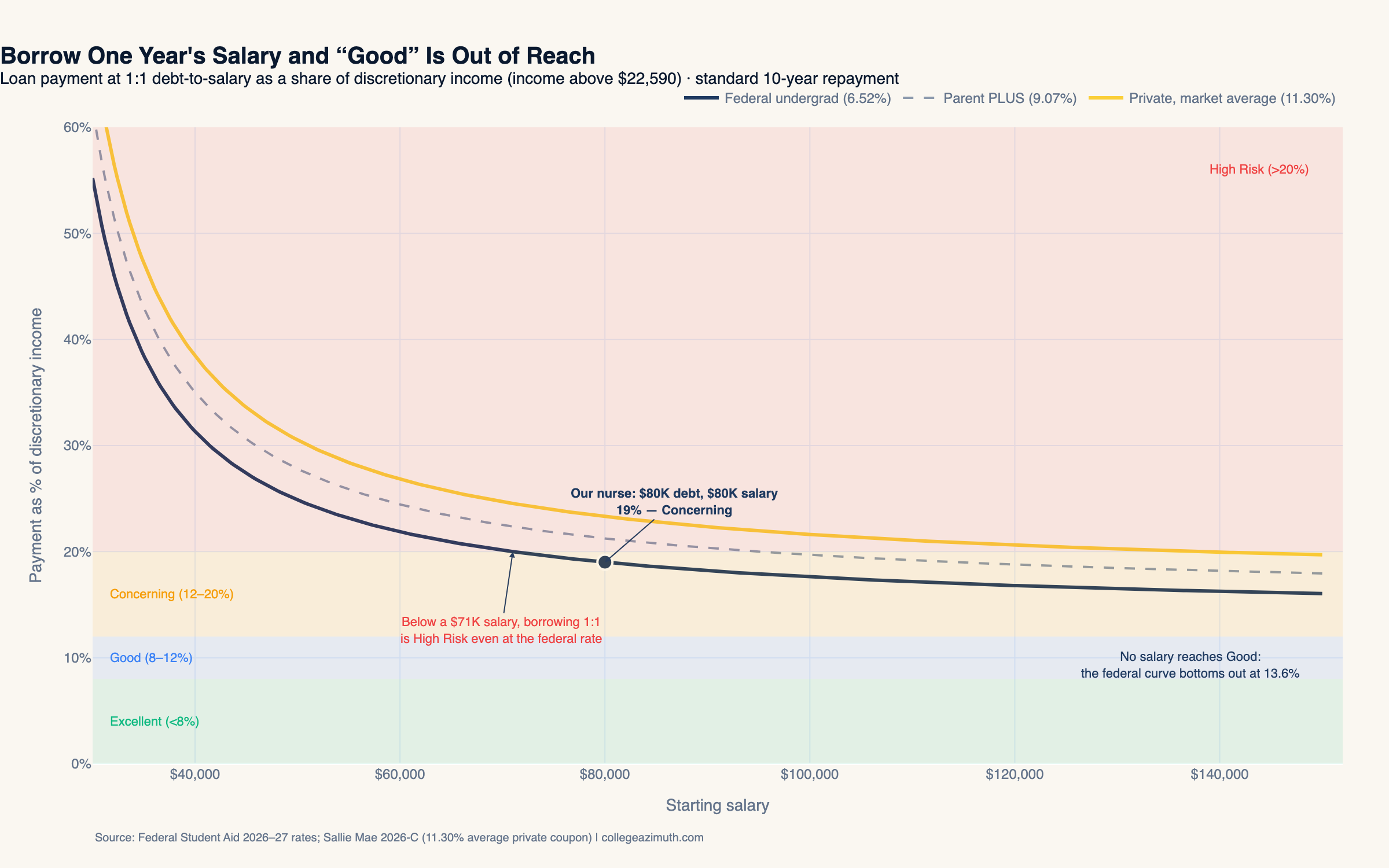
Flip it around and it's even starker: for the $80,000 our nurse is weighing, landing in the Good tier requires a starting salary north of $113,000 — at the cheapest rates available.
Where you live changes the answer
That $22,590 floor is a national average, and I flagged this caveat when I built the GPS: it doesn't know that rent in San Francisco runs three times Indianapolis. So let's fix that. MIT's Living Wage Calculator[8] prices what a single adult actually needs, city by city — $45,442 a year in Indianapolis, $67,469 in San Francisco, against that $22,590 statutory floor.
Re-run our boundary case — $80K debt, $80K salary, the loan the rule is most confident about — against real city budgets, and the "Concerning" verdict disappears. It's High Risk in every one of the nine metros I pulled: about 30% of discretionary income in Wichita, 32% in Indianapolis, 40% in Chicago, 87% in San Francisco. In Manhattan, the basic single-adult budget is $79,469 a year, and there is effectively nothing left to pay with. Only the national average makes 80/80 look survivable.
But salaries move with geography too, so let's be fair to the rule and make our nurse real. Registered-nurse pay, from the BLS, May 2025[9]:
| Nurse | RN salary | The rule says | Against the local budget |
|---|---|---|---|
| Indianapolis — 10th percentile | $69,160 | over the line | 46% — High Risk |
| Indianapolis — 25th percentile | $79,080 | over the line, by $920 | 32% — High Risk |
| Indianapolis — median | $84,230 | "workable" | 28% — High Risk |
| San Francisco — 25th percentile | $137,120 | "workable" | 16% — Concerning |
| San Francisco — median | $186,610 | "workable" | 9% — Good |
Look at what the rule does with this. The Indianapolis median nurse clears it — $84,230 against $80,000 of debt — and then hands over 28% of her real discretionary income, deep in High Risk. The San Francisco median nurse also clears it, and at 9% she genuinely is fine. The rule hands both of them the same passing grade. Meanwhile the Indianapolis nurse at the 25th percentile misses the line by $920 — as if $920 of salary is what separates her from safety, while she's staring at 32%.
And this isn't an Indianapolis quirk. Pull the median RN wage in every one of these metros and it lands below the local escape salary in seven of the nine — Wichita, Pittsburgh, Indianapolis, Chicago, Phoenix, Boston, New York. Houston clears the line by $299. Only San Francisco's nurses, at $186,610, actually reach Good.
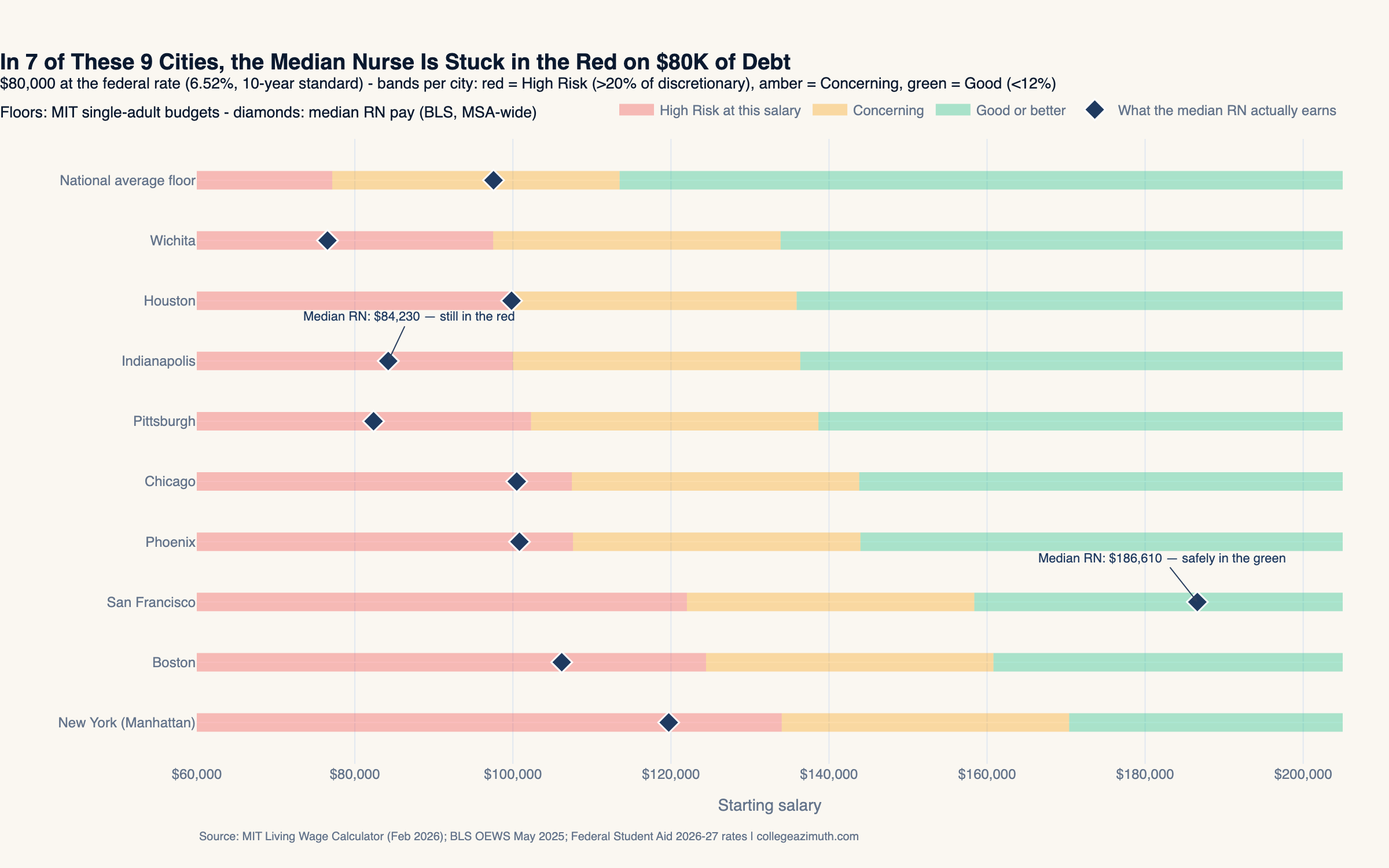
(One caveat worth stating plainly: those BLS figures describe all RNs in a metro, not new graduates — entry pay runs lower. Which makes every number in that table more generous than reality, not less.)
Under real city budgets, escaping High Risk at 1:1 takes about a $143,000 starting salary in Indianapolis and $212,000 in San Francisco. The national-average version of that number was $71,000.
And notice we're still carrying the rule's most generous assumption: that all of this debt borrows at the federal rate. Time to fix that too.
The Reality of 80k in Student Debt.
Now let's take back the generous assumption. A dependent undergrad can borrow at most $31,000 total in federal student loans[10] across an entire undergraduate career. That's the cap. (Qualify as an independent student — most traditional 18-year-olds don't — and it rises to $57,500.) Our nurse's other $49,000 has to come from somewhere else — and in her own name, that means private loans, priced on credit.
So what does private money cost? This month, Sallie Mae packaged about two billion dollars of its student loans for investors, and the servicing report[11] reads like a best-case scenario: 94% of the loans had cosigners, and more than half the balance belonged to borrowers with FICO scores above 740. A strong pool. Its average interest rate: 11.30%. The deferred-payment loans — the kind most students in school actually take — averaged 12.41%. Advertised private rates[12] this summer run as high as 18%.
Let's run those numbers. Remember, the one-liner has always traveled with a companion test[13]: keep payments under 10% of gross income, 15% at a stretch, which is consistent with our GPS framework.
At the market-average 11.30%, borrowing 1:1 produces payments of 16.7% of gross income — past the stretch limit at the market average, not at some extreme. At 18%, staying inside the stretch limit caps borrowing at 0.69× salary, and the preferred 10% version caps it at 0.46×.
At real private rates, the balance rule and the payment rule can't both be true.
One more mechanical detail: loans deferred during school accrue interest the whole time, and it capitalizes when repayment begins. The ratio you calculated at signing understates the balance you'll actually repay.
Which brings us back to the answer that started all this. Remember, the model hedged — it suggested keeping payments under about 10% of gross income.
Convert that caveat to dollars and it becomes a borrowing ceiling: at an $80,000 salary, roughly $57,000 of debt at 7%, $48,000 at the market-average rate, $37,000 at the advertised ceiling — every one far below the $80,000 the model called workable. The answer identified the right risks, one by one, and never combined them to give an answer. It quietly put the burden back on the individual who wouldn't be asking if they were equipped to do it: an 18-year-old who will remember "nursing pays well" and "workable," and not much else.
Here is what the AI said when I pointed all of this out to it:
"The answer an unsupported 18-year-old actually needed was closer to: Do not commit to borrowing $80,000 yet. On ordinary ten-year repayment, that amount is likely too high relative to a nurse's starting salary. Even at 7%, the payment would be about $929 per month, which already exceeds the suggested limit for an $80,000 salary. At contemporary private-loan rates, the payment could exceed $1,100–$1,400 per month. The plan becomes potentially defensible only if a substantial portion is low-rate federal debt, forgiveness is genuinely likely, or you can reduce the amount borrowed substantially. Get the exact loan types, rates, and projected balance at graduation before deciding."
That answer exists inside the same model that said "workable." It produced it only after someone who knew the terrain made it do the math — and almost nobody asking is in a position to push.
And none of this touches the more complex questions: completion, transfer paths, whether the degree is worth it at all. Payable and worth it are different questions, and the ambiguity and confident "workability" is in and of itself a part of the problem.
Sources
- Daniel Rogers, "Some Thoughts on AI and College and Career Decisions," College Azimuth, April 2026.
- Renaissance Philanthropy, "Can AI Give Reliable Career Advice? Evaluating LLMs Using CareerNet," 2025.
- Mark Kantrowitz, "What is Gainful Employment? What is Affordable Debt?" Student Aid Policy Analysis, March 2010.
- Sandy Baum & Saul Schwartz, "How Much Debt Is Too Much? Defining Benchmarks for Manageable Student Debt," College Board, 2006.
- Daniel Rogers, "Financial GPS: How to Navigate College Debt Without Drowning," College Azimuth, January 2026.
- Consumer Financial Protection Bureau, "How much should I borrow in student loans?"
- Federal Student Aid, interest rates for Direct Loans first disbursed July 1, 2026 – June 30, 2027, June 2026.
- MIT Living Wage Calculator, county estimates for a single adult, updated February 2026.
- U.S. Bureau of Labor Statistics, Occupational Employment and Wage Statistics, May 2025 — Registered Nurses (29-1141), national and metro wage percentiles.
- Federal Student Aid, "Subsidized and Unsubsidized Loans" — annual and aggregate loan limits.
- Sallie Mae, SMB Private Education Loan Trust 2026-C distribution report, July 15, 2026.
- NerdWallet, "Best Private Student Loans," updated July 23, 2026.
- Mark Kantrowitz, "Student Loan 101: What Is Debt-to-Income Ratio?" Saving for College, updated March 2022.
- Janet Hansen & Marilyn Rhodes, "Student Debt Crisis: Are Students Incurring Excessive Debt?" 1985 — a review of the affordability models built from the late 1960s onward.